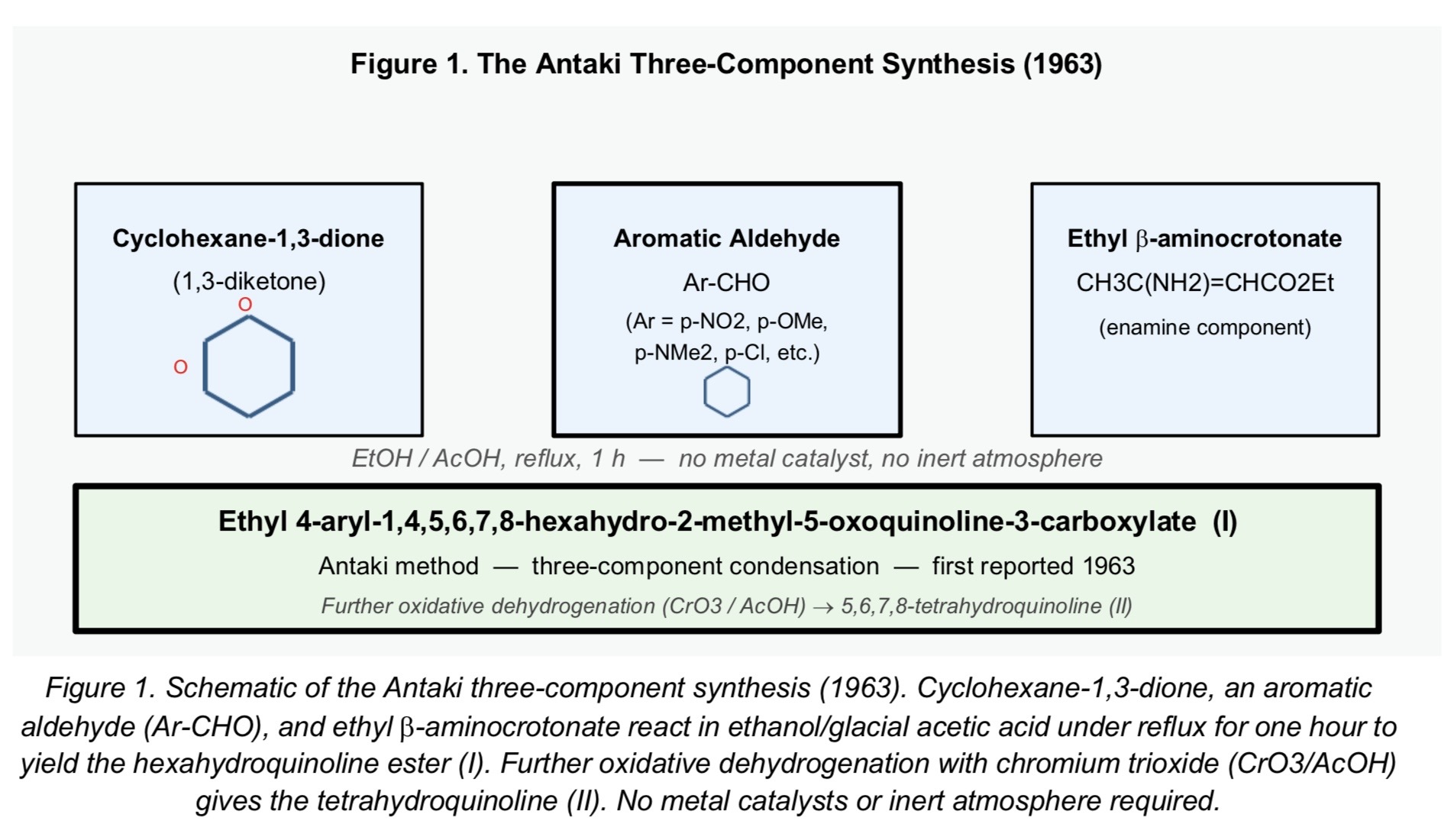
In 1963, Hekmat Bechir Fathallah Antaki reported the first synthesis of hexahydroquinoline derivatives, preparing ethyl 4-aryl-1,4,5,6,7,8-hexahydro-2-methyl-5-oxoquinoline-3-carboxylates via three-component condensation of cyclohexane-1,3-dione, aromatic aldehydes, and ethyl β-aminocrotonate in ethanol and glacial acetic acid under reflux for one hour.
Antaki developed the synthesis because 5,6,7,8-tetrahydro-5-oxoquinolines were required for other work, while the few routes then reported for the synthesis of Bz-tetrahydroquinolines were, in his words, "not adaptable for preparation of these derivatives." The three-component condensation he introduced provided direct access to the required derivatives.
The reported synthesis uses no transition-metal catalyst or inert atmosphere. The three components are combined under ordinary reflux conditions, and in the reported preparations the product crystallises directly from the reaction mixture. Antaki reported a full series of aryl substituents at the 4-position — p-nitrophenyl, p-methoxyphenyl, 3,4-dimethoxyphenyl, p-dimethylaminophenyl, p-chlorophenyl, and o-nitrophenyl derivatives — with melting points and elemental analyses fully documented.
The hexahydroquinoline intermediates were further subjected to oxidative dehydrogenation by chromium trioxide in dilute acetic acid to yield the corresponding 5,6,7,8-tetrahydroquinolines, demonstrating controlled manipulation of scaffold oxidation state.
| Parameter | Detail |
|---|---|
| Reactants | Cyclohexane-1,3-dione · Aromatic aldehyde · Ethyl β-aminocrotonate |
| Solvent | Ethanol and glacial acetic acid |
| Temperature | Reflux |
| Reaction time | 1 hour |
| Workup | Product crystallises directly from the reaction mixture |
| Catalyst | None — no transition metal catalysts required |
| Atmosphere | Ambient — no inert atmosphere required |
| Aryl substituents reported | p-nitrophenyl, p-methoxyphenyl, 3,4-dimethoxyphenyl, p-dimethylaminophenyl, p-chlorophenyl, o-nitrophenyl |
| Oxidation step | Chromium trioxide in dilute acetic acid — converts hexahydroquinolines to tetrahydroquinolines |
The 1963 paper did not stop at the hexahydroquinoline series. Antaki also showed that replacing ethyl β-aminocrotonate with ammonium acetate redirected the same direct condensation chemistry toward 9-aryldecahydro-1,8-dioxoacridines.
Two years later he returned specifically to this branch of the method. The opening sentence of his 1965 paper makes the continuity explicit:
"After synthesis of 9-aryldecahydro-1,8-dioxoacridines by condensing aromatic aldehydes with cyclohexane-1,3-dione in presence of ammonium acetate we have extended the reaction to aromatic amines…" — H. Antaki, J. Chem. Soc., 1965, 2263–2264
In the 1965 extension, aromatic amines replaced ammonium acetate, allowing direct preparation of 9,10-diaryl-1,8-dioxodecahydroacridines. For example, p-nitrobenzaldehyde, cyclohexane-1,3-dione and aniline were refluxed together in glacial acetic acid for one hour to give the corresponding 9,10-diaryl acridinedione.
The significance of the paper lies in the adaptability of the method. The nitrogen component could be changed while retaining the same convergent approach: relatively simple components were brought together directly to construct a condensed nitrogen heterocycle.
Antaki also tested how the chemistry proceeded. With 2-aminopyridine and its 4-methyl derivative, the corresponding octahydro-1,8-dioxoxanthene was isolated instead. Treatment of that xanthene with aromatic amines returned it unchanged, leading Antaki to conclude that the aromatic-amine reaction did not proceed through the isolated xanthene. He also showed that xanthenes could be converted smoothly to acridines with ammonium acetate, while arylidene-biscyclohexane-1,3-diones reacted with aromatic amines to give 9,10-diaryl acridinediones.
The 1965 paper therefore did more than add derivatives. It demonstrated that the chemistry introduced in 1963 could be extended into a broader synthetic method.
The continuity between the 1963 and 1965 papers was recognised in the specialist literature within a decade. In I. A. Selby's chapter Acridinium Salts and Reduced Acridines, in R. M. Acheson (ed.), Chemistry of Heterocyclic Compounds: Acridines, Vol. 9 (Wiley, 1973), Antaki's 1963 paper appears as reference 324 for the preparation of decahydro-1,8-acridinediones from aromatic aldehydes, cyclohexane-1,3-dione and ammonium acetate. The immediately following discussion cites Antaki's 1965 paper as reference 325 for the use of aromatic amines instead of ammonium acetate to give 9,10-diaryldecahydro-1,8-acridinediones. The two papers were thus presented consecutively as stages in the same synthetic development. DOI: 10.1002/9780470186596.ch6
A second specialist review followed in 1974. A. Ya. Strakov, E. Yu. Gudrinietse and D. R. Zitsane, Synthesis of Heterocyclic Compounds from Cyclohexane-1,3-diones (review), Chemistry of Heterocyclic Compounds 10 (1974), 881–897, cites Antaki's 1965 paper as reference 136 and his 1963 paper as reference 138. The 1963 paper is specifically cited for direct formation of decahydroacridines from cyclohexane-1,3-diones, aromatic aldehydes and ammonium acetate; the 1965 paper is cited within the related acridinedione chemistry. DOI: 10.1007/BF00487103
Antaki's 1963 work made the hexahydroquinoline framework accessible through a direct synthetic route and demonstrated systematic variation of the aryl substituent. That combination — an accessible scaffold with a modifiable aryl position — provided a practical platform for later medicinal-chemistry development.
Twenty-six years later, Bossert and Vater described how hexahydroquinoline derivatives had drawn their attention:
“Hexahydroquinoline derivatives7 aroused our interest. The surprisingly good effect of 4-α-pyridylhexahydroquinoline-3-carboxylic acid ester 72, which, because of its basic center, was the first of these compounds to be synthesized, became apparent in the IV study, but was not obtainable in the oral study.”
Reference 7 is Antaki's 1963 Journal of the Chemical Society paper. Bossert and Vater therefore document Antaki's HHQ chemistry directly within the historical development of this medicinal-chemistry class.
Bossert, F.; Vater, W. 1,4-Dihydropyridines—a basis for developing new drugs. Medicinal Research Reviews 9 (1989), 291–324. DOI: 10.1002/med.2610090304
The method later appeared in two very different application areas.
In 1993, Palanisamy Shanmugasundaram, K. Joseph Prabahar and Vayalakkavoor T. Ramakrishnan explicitly returned to Antaki's 1965 procedure while developing acridinediones as a new class of laser dyes. Antaki's 1965 paper is their reference 7, and his 1963 paper is reference 8. They wrote:
"Antaki [7] reported the condensation of 2,2′-arylidene-bis(cyclohexane-1,3-diketone) with aromatic amines giving very low yields of acridinediones. The above procedure was modified to obtain the products 2 in good yields."
The authors experimentally revisited the earlier conditions. Refluxing the arylidene-bis(cyclohexane-1,3-dione) and aromatic amine in 100 mL of acetic acid produced only traces of acridinedione, with dioxoxanthene as the major product; reducing the acetic-acid volume to 10 mL gave good yields. The resulting acridinediones were investigated as laser dyes, with several lasing around 475–495 nm and compared experimentally with coumarin 102. The connection is therefore methodological, not merely bibliographic: Antaki's 1965 procedure was tested, modified and improved. DOI: 10.1002/jhet.5570300428
A separate industrial application appeared at approximately the same time. Zeneca/ICI patents concerning therapeutic acridine-1,8-diones described routes involving an aromatic aldehyde, ammonia or an ammonium salt, and cyclohexane-1,3-dione. In discussing suitable conditions, the patent states:
"Suitable reaction conditions are also reported by Antaki in J. Chem. Soc., 4877 (1963)."
The citation establishes Antaki's 1963 conditions as relevant synthetic precedent for Zeneca's acridinedione patent chemistry. EP 0539154 B1
Among the downstream uses identified so far, these provide two particularly distinct examples of the method's later reach: acridinediones developed as laser-active materials and acridinediones investigated in industrial therapeutic chemistry. The applications were unrelated; the common element was the continuing utility of the synthetic method.
Returning to the hexahydroquinoline series that opened this synthesis, the method has been formally classified as the Antaki synthesis — alongside the Hantzsch and Stankevich reactions — as one of three foundational multicomponent methods for hexahydroquinoline formation:
"These approaches established the mechanistic foundation for multicomponent HHQ formation and provided a framework for structural diversification in modern synthesis." — Oduselu et al., Frontiers in Chemistry, 2026
DOI: 10.3389/fchem.2026.1769586
The 1963 J. Chem. Soc. paper entered industrial patent literature through a substantial group of later pharmaceutical filings. The patents below are the families in the documented patent record that specifically cite the 1963 synthesis; patents citing Antaki's 1951, 1958, or 1962 papers are not included here.
| Patent | Assignee | Published |
|---|---|---|
| EP 0539153 | Zeneca | 1993 |
| EP 0539154 | Zeneca | 1993 |
| US 5,258,390 | ICI / AstraZeneca | 1993-11-02 |
| CA 2080950 | ICI / Zeneca | 1993 |
| CA 2080949 | ICI / Zeneca | 1993 |
| US 5,340,819 | ICI | 1994-08-23 |
| US 5,455,253 | Zeneca | 1995-10-03 |
| US 5,484,792 | ICI | 1996 |
| US 5,622,964 | Zeneca | 1997-04-22 |
| US 8,716,319 | Gilead Sciences | 2014-05-06 |
The Zeneca/ICI family is discussed above because it directly identifies Antaki's 1963 reaction conditions as suitable precedent for acridinedione preparation. The later Gilead citation shows that the 1963 paper remained present in pharmaceutical prior art decades afterward.
Antaki carried out this work within an institutional programme whose stated priorities included the eradication of malaria in Egypt and the control of diseases transmitted by medical insects and their vectors. His own published chemistry also records explicit antiparasitic aims:
"In continuation of previous work on the schistosomicidal activity in the pyrido[1,2-a]pyrimidine series, the synthesis of some basic derivatives was considered." — H. Antaki, J. Org. Chem., 1962. DOI: 10.1021/jo01051a058
Against that biomedical background, the later appearance of the hexahydroquinoline scaffold in antimalarial research is notable. In 2017, Vanaerschot and colleagues screened 3,825 compounds from the Novartis-GNF Malaria Box and identified three hexahydroquinolines with potent blood-stage and transmission-blocking activity against malaria parasites. DOI: 10.1038/s41564-017-0007-4
The 2017 work represents a later biological development within the closely related hexahydroquinoline scaffold family.
Independent screening also provided direct biological evidence for one of Antaki's own 1963 HHQ compounds. His 4-(4-nitrophenyl) hexahydroquinoline was active against Plasmodium falciparum — EC50 0.57 µM against the drug-resistant W2 strain and 0.90 µM against the drug-susceptible 3D7 strain — while cytotoxicity against human Huh7 cells appeared only at CC50 100 µM, a selectivity of roughly two orders of magnitude in that screening system (PubChem CID 2845068).
Selby, I. A. Acridinium Salts and Reduced Acridines, in R. M. Acheson (ed.), Chemistry of Heterocyclic Compounds: Acridines, Vol. 9, Wiley, 1973. DOI: 10.1002/9780470186596.ch6
Strakov, A. Ya.; Gudrinietse, E. Yu.; Zitsane, D. R. Synthesis of Heterocyclic Compounds from Cyclohexane-1,3-diones (review). Chemistry of Heterocyclic Compounds 10 (1974), 881–897. DOI: 10.1007/BF00487103
Bossert, F.; Vater, W. 1,4-Dihydropyridines—a basis for developing new drugs. Medicinal Research Reviews 9 (1989), 291–324. DOI: 10.1002/med.2610090304
Shanmugasundaram, P.; Prabahar, K. J.; Ramakrishnan, V. T. A New Class of Laser Dyes from Acridinedione Derivatives. Journal of Heterocyclic Chemistry 30 (1993), 1003–1007. DOI: 10.1002/jhet.5570300428
Vanaerschot, M. et al. Hexahydroquinolines are antimalarial candidates with potent blood-stage and transmission-blocking activity. Nature Microbiology 2 (2017), 1403–1414. DOI: 10.1038/s41564-017-0007-4
Mamaghani, M.; Larghani, T. H. Ultrasound promoted one-pot three-component synthesis of novel 7-aryl-8H-benzo[h]indeno[1,2-b]quinolin-8-ones under solvent-free conditions. Journal of Chemical Research 36 (2012), 235–237. DOI: 10.3184/174751912X13319177859559
Oduselu, G. O. et al. Emerging insights into chemistry and therapeutic potentials of functionalized hexahydroquinolines. Frontiers in Chemistry (2026). DOI: 10.3389/fchem.2026.1769586
Antaki, H. The Synthesis of Ethyl 4-Aryl-5,6,7,8-tetrahydro-5-oxoquinoline-3-carboxylates and their Derivatives. J. Chem. Soc. 1963, 4877–4879. DOI: 10.1039/JR9630004877
Antaki, H. Some Derivatives of Decahydro-1,8-dioxoacridine. J. Chem. Soc. 1965, 2263–2264.
Antaki, H. Synthetic Routes to Benz- and Naphth-indenoquinolines. J. Chem. Soc. C 1967, 1581–1582. DOI: 10.1039/J39670001581
A Perspective consolidating the synthesis, its spectroscopic framework, and its antimalarial relevance is available as a preprint on ChemRxiv:
View Preprint on ChemRxiv →