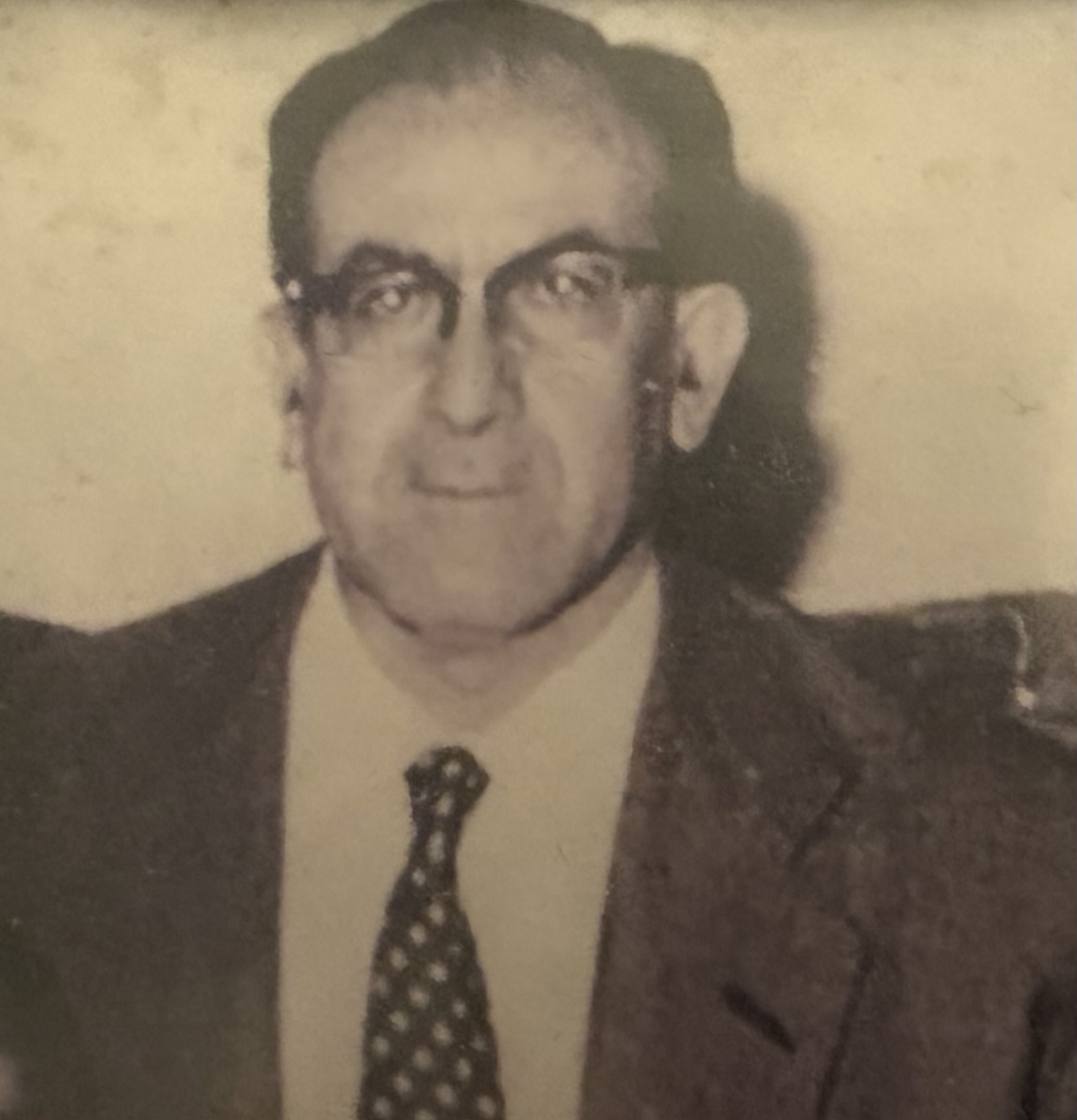
H. B. F. Antaki, Cairo, circa 1960s
Hekmat Bechir Fathallah Antaki was an Egyptian organic chemist. His 1963 method for synthesising hexahydroquinoline scaffolds — later named the Antaki method in a 2026 review in Frontiers in Chemistry, alongside the Hantzsch and Stankevich reactions — remains part of the working vocabulary of heterocyclic chemistry today. He completed his doctoral degree at Queen Mary College, University of London, in 1950, under the supervision of J.R. Partington. He was elected a Fellow of the Chemical Society on 14 October 1948 (J. Chem. Soc., 1948, p. 104; DOI 10.1039/JR94800BA001). He returned to Egypt and joined the Research Institute for Tropical Medicine, Cairo, where he conducted an independent programme of research in heterocyclic chemistry between 1951 and 1967. He subsequently served as Director in the Research Institute of Medical Entomology, Cairo.
He published ten papers between 1951 and 1968, spanning organic heterocyclic chemistry and medical research. Eight appeared in leading chemistry journals; the remaining two dealt with the polarographic determination of antimony blood levels during stibophen therapy of schistosomiasis and with the metabolism and excretion of nitrothiamidazole. Working without university affiliation, he developed multicomponent condensation methods for the synthesis of pharmacologically relevant heterocyclic scaffolds. His 1962 paper was submitted from his home address in Agouza, Cairo.
The documents reproduced below are from his 1950 doctoral thesis, Contributions to the Chemistry of Heterocyclic Compounds, Queen Mary College, University of London.
Across his wider programme in heterocyclic chemistry, Antaki established and investigated several condensed ring systems. Two of these later became especially prominent medicinal-chemistry scaffolds.
A privileged scaffold in medicinal chemistry, its derivatives studied across cardiovascular, antiallergic, antiasthmatic and antiparasitic research. The structure of the parent ring system was established by Antaki and Petrow in 1951 (J. Chem. Soc., 1951, 551–555; DOI: 10.1039/JR9510000551) and was later described as "first described by Antaki" in the authoritative review of the series by Hermecz and Mészáros (Advances in Heterocyclic Chemistry, 1983, 33, 241–330; DOI: 10.1016/S0065-2725(08)60055-0).
In 1958, Antaki prepared 3-acetyl- and 3-cyano-4H-pyrido[1,2-a]pyrimidin-4-ones by condensation of 2-aminopyridines with α-ethoxymethylenecarboxylic esters, followed by cyclisation under reduced pressure (J. Am. Chem. Soc., 1958, 80, 3066–3069; DOI: 10.1021/ja01545a041). That paper was later cited in Bristol-Myers patents US 4,122,274 and US 4,209,620 concerning 3-(1H-tetrazol-5-yl)-4H-pyrido[1,2-a]pyrimidin-4-one antiallergic agents.
This ring system is the heterocyclic core of the antipsychotics risperidone and paliperidone. The defining patent (US 4,804,663) names as its two most-preferred compounds the reduced 6,7,8,9-tetrahydro-2-methyl-4H-pyrido[1,2-a]pyrimidin-4-one and the corresponding aromatic 2-methyl-4H-pyrido[1,2-a]pyrimidin-4-one. The marketed drugs carry the ring in reduced, 3-substituted form — paliperidone being the 9-hydroxy metabolite of risperidone. The ring system is the one established in 1951; the reduction, 3-substitution and pharmacology are Janssen's.
A scaffold of active medicinal interest, belonging to the privileged quinoline family and pursued in current anticancer and antimalarial research. Antaki reported the first practical three-component synthesis of the 4-aryl-hexahydroquinoline in 1963 — a method now formally named the Antaki synthesis (Oduselu et al., Frontiers in Chemistry, 2026). He built it because the routes then available were, in his own words, "not adaptable for preparation of these derivatives." The inventors of nifedipine later placed that chemistry directly at the beginning of their own dihydropyridine programme. In their 1989 retrospective, Bossert and Vater wrote that "hexahydroquinoline derivatives… aroused our interest," citing Antaki's 1963 paper as reference 7. Their first compound in that series, a 4-α-pyridylhexahydroquinoline ester, showed a surprisingly good intravenous effect but no oral effect; they described the "crucial advance" as its "open ringed" 1,4-dihydropyridine analogue, which was active by both routes. Decades later, independent antimalarial screening found his 4-(4-nitrophenyl) compound active against Plasmodium falciparum, including a drug-resistant strain, with roughly 175-fold selectivity over human cells in that screening system (EC₅₀ 0.57 µM vs. CC₅₀ 100 µM; PubChem CID 2845068). The scaffold remains an active platform across the pharmaceutical patent record.
Independent parties — patent attorneys, review authors, and research chemists — described his work in their own words.
"The synthesis of a 1H-pyrimido[1,2-a]quinoline appears to have first been reported by Antaki et al., J. Chem. Soc., pp. 551–555 (1951)."
— Pfizer, US 4,066,766 (1978)
"hexahydroquinoline derivatives… aroused our interest."
— Bossert and Vater, inventors of nifedipine, citing Antaki's 1963 paper as reference 7 at that step. They then describe their first 4-α-pyridylhexahydroquinoline as active intravenously but inactive orally, followed by the "crucial advance" to its "open ringed" 1,4-dihydropyridine analogue. Medicinal Research Reviews 9, 291–301 (1989). DOI: 10.1002/med.2610090304
Products of 4-methylpyridine and ethoxymethylene cyanoacetate "were first described by Antaki."
— Hermecz and Mészáros, the canonical review of the ring system. Advances in Heterocyclic Chemistry, Vol. 33 (1983), pp. 241–330. DOI: 10.1016/S0065-2725(08)60055-0
Their products were "identical in m.p., ir, uv, and pmr spectra… as described by Antaki and Petrow" — confirmed by X-ray crystallography and NMR.
— Yale, Toeplitz, Gougoutas and Puar, Squibb Institute for Medical Research. J. Heterocyclic Chem. 10, 123 (1973). DOI: 10.1002/jhet.5570100132
The angular formulation "was revised by Antaki and Petrow to the linear structure, based upon the known reactivity of C₂-methylene in the 5α-series."
— Y. Ban and Y. Sato, Chem. Pharm. Bull. 13, 1073 (1965). DOI: 10.1248/cpb.13.1073.
"Suitable reaction conditions are also reported by Antaki in J. Chem. Soc., 4877 (1963)."
— Zeneca, EP 0539154 (1997).
The full record — patents, reviews, reference works, and laboratory use, in their authors' own words: In Their Own Words
Named reaction. His 1963 hexahydroquinoline synthesis has been formally classified as the Antaki synthesis, alongside the Hantzsch and Stankevich reactions, as one of three foundational multicomponent methods for that scaffold class. Oduselu et al., Frontiers in Chemistry, 2026. DOI: 10.3389/fchem.2026.1769586
"Traditional multicomponent reactions such as the Hantzsch, Antaki, and Stankevich methods are discussed alongside more recent green synthetic strategies." — Oduselu et al., Frontiers in Chemistry, 2026.
The 2026 name formalises a distinction the field had already drawn. As early as 1972, Eisner and Kuthan's review of dihydropyridine chemistry cited the 1963 paper as the source for a method introduced as "another method" apart from the classical Hantzsch approach: condensation of aldehydes with cyclic 1,3-diketones. Chem. Rev. 72(1), 1–42 (1972), ref. 374. DOI: 10.1021/cr60275a001. The procedure also remained in practical use in later synthetic work: Zeneca patent EP 0539154B1 (1997) states, "Suitable reaction conditions are also reported by Antaki in J. Chem. Soc., 4877 (1963)."
| # | Patent | Assignee | Published | Paper cited |
|---|---|---|---|---|
| 1 | US 3,538,086 | CIBA (Switzerland) | 1970-11-03 | 1951 JCS |
| 2 | US 4,014,881 | Pfizer | 1977-03-29 | 1951 JCS + 1958 JACS |
| 3 | US 4,017,625 | Pfizer | 1977-04-12 | 1951 JCS + 1958 JACS |
| 4 | US 4,022,897 | E.R. Squibb | 1977-05-10 | 1951 JCS |
| 5 | US 4,031,217 | Pfizer | 1977-06-21 | 1951 JCS + 1958 JACS |
| 6 | US 4,041,163† | Pfizer | 1977-08-09 | 1951 JCS |
| 7 | US 4,066,766† | Pfizer | 1978-01-03 | 1951 JCS + 1958 JACS |
| 8 | US 4,122,274 | Bristol-Myers | 1978-10-24 | 1958 JACS |
| 9 | US 4,209,620† | Bristol-Myers | 1980-06-24 | 1958 JACS |
| 10 | US 4,223,031 | Mead Johnson | 1980-09-16 | 1951 JCS |
| 11 | US 4,491,587 | Mead Johnson | 1985-01-01 | 1951 JCS |
| 12 | US 4,762,840 | Roussel-Uclaf (Sanofi) | 1988 | 1951 JCS |
| 13 | US 5,166,206 | Merck | 1992-11-24 | 1951 JCS |
| 14 | EP 0539153† | Zeneca | 1993 | 1963 JCS |
| 15 | EP 0539154† | Zeneca | 1993 | 1963 JCS |
| 16 | US 5,258,390† | ICI/AstraZeneca | 1993-11-02 | 1963 JCS |
| 17 | CA 2080950† | ICI / Zeneca | 1993 | 1963 JCS |
| 18 | CA 2080949† | ICI / Zeneca | 1993 | 1963 JCS |
| 19 | US 5,324,729 | Merck | 1994-06-28 | 1951 JCS |
| 20 | US 5,340,819† | ICI | 1994-08-23 | 1963 JCS |
| 21 | US 5,455,253† | Zeneca | 1995-10-03 | 1963 JCS |
| 22 | US 5,484,792† | ICI | 1996 | 1963 JCS |
| 23 | US 5,622,964† | Zeneca | 1997-04-22 | 1963 JCS |
| 24 | US 8,716,319 | Gilead Sciences | 2014-05-06 | 1963 JCS |
| 25 | WO 2015/002150 | Shin Nippon Biomedical Labs | 2015-01-08 | 1951 JCS |
| 26 | US9745274 | Shin Nippon Biomedical Labs | 2017-08-29 | 1951 JCS |
| 27 | US 3,898,224 | E.R. Squibb | 1975-08-05 | 1962 JOC (examiner-cited) |
| 28 | US 3,907,798 | Sterling Drug (STWB) | 1975-09-23 | 1951 JCS (via Chem. Abstr. 45, 9061d) |
| 29 | WO 1998/056761 | Glaxo Group / University of Michigan | 1998-12-17 | 1951 JCS (glycosylbenzimidazoles) |
† Patent specification discusses Antaki’s work explicitly in the text, rather than merely listing it among references or cited prior art. Selected quotations appear on In Their Own Words.
Twenty-nine direct patents verified at text level as of 22 September 2026. Six countries. 1970–2017. Full record with remarks: In Their Own Words
Citation through the record: the examiner chain. Beyond the direct citations above, later patents also preserve a second-order citation trail through US 4,122,274 (Bristol-Myers, 1978). Google Patents marks Antaki's 1958 JACS paper with the examiner asterisk in the citation list of US 4,122,274; independently of that metadata, the patent specification itself explicitly cites Antaki in its text for the relevant acrylate starting materials. Two later, unrelated patent families on the same ring system in turn cite US 4,122,274:
| Patent | Assignee / subject | Connection to Antaki |
|---|---|---|
| US 9,006,431 | Pemirolast sodium, crystalline form (antiallergic) | Cites US 4,122,274; the product patent reproduces the Bristol-Myers synthesis by name in its own comparative examples |
| US 9,586,955 | Roche / PTC Therapeutics — compounds for spinal muscular atrophy (risdiplam) | Cites US 4,122,274 directly among its patent citations |
These two are not counted among the twenty-nine direct citations above; they are included here as a documented second-order record of how far the citation trail extends.
In 1911, Palazzo and Tamburini prepared the first compound in the pyrido[1,2-a]pyrimidine series but assigned it the wrong structure (2-oxo instead of 4-oxo). This error was repeated by Seide (1925) and Crippa & Scevola (1937) and remained in the chemical literature for nearly forty years.
In 1951, Hekmat Bechir Fathallah Antaki, working with V. Petrow at Queen Mary College London, resolved the long-standing error. Using an independent synthesis (reacting 2-bromopyridine with ethyl β-aminocrotonate), they conclusively demonstrated that the correct structure was the 4-oxo isomer — borrowing the words of Hermecz and Mészáros (Advances in Heterocyclic Chemistry, Vol. 33, 1983): "unequivocal synthesis." This assignment was independently confirmed by ultraviolet spectroscopy by Adams and Pachter (1952) and explicitly credited as the definitive proof by Shur and Israelstam (1968) and by Hermecz and Mészáros, who further noted it was "first described by Antaki" (p. 269).
![Reaction scheme from doctoral thesis 1950: 2-aminopyridine routes to pyrido[1,2-a]pyrimidine](/thesis-pyrido-scheme.jpg)
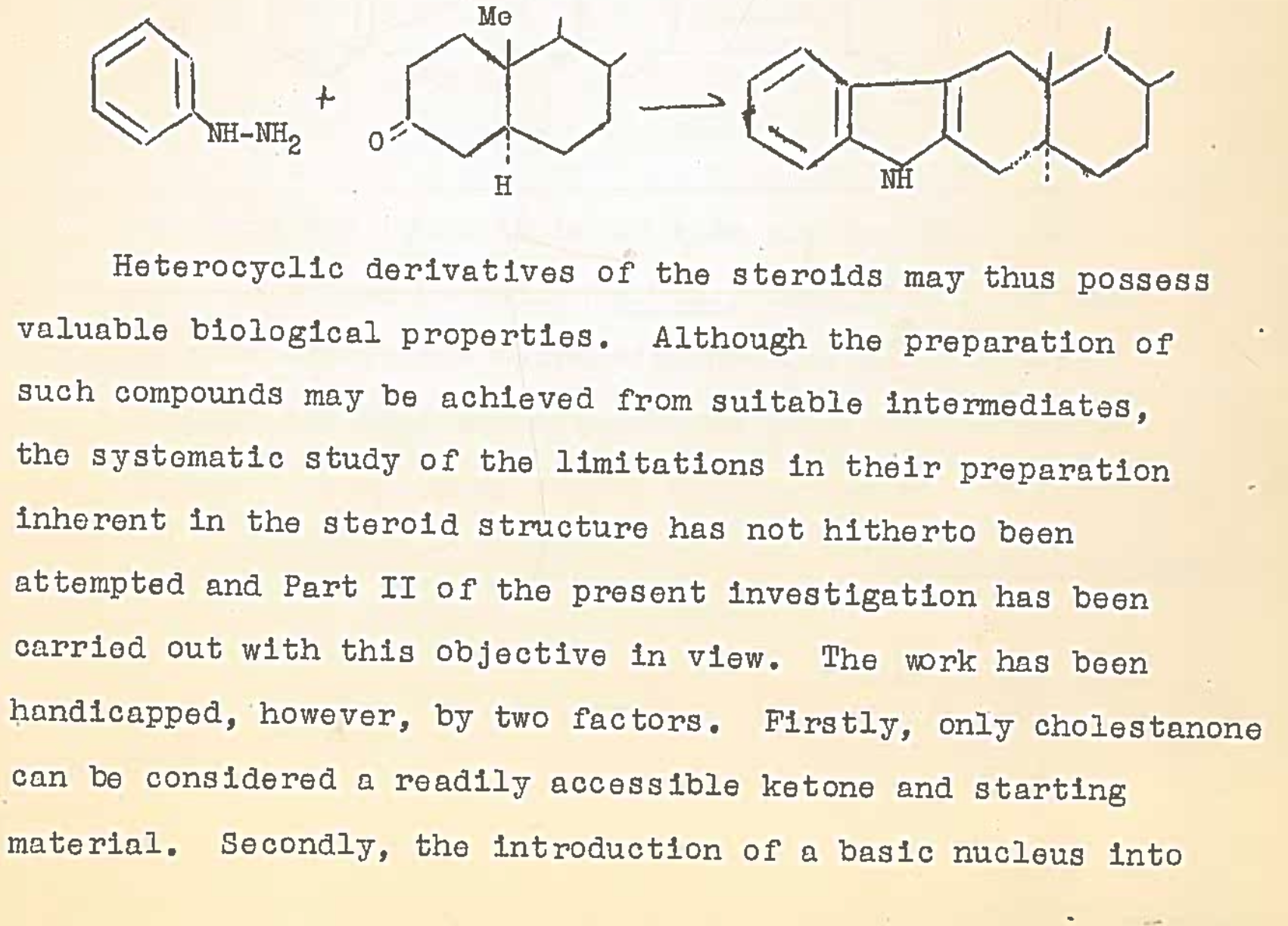
In Part II of his doctoral thesis, Contributions to the Chemistry of Heterocyclic Compounds (Queen Mary College, University of London, 1950, pp. 91–94), Antaki re-examined the indolo-cholestane that Dorée and Petrow had formulated as the angular isomer in 1935. The angular assignment had rested on surface-film measurements that were themselves inconclusive. Working from the established chemistry of the cholestanones, Antaki reassigned the structure from the angular [2′:3′-3:4] to the linear [2′:3′-3:2] cholestane. The revised assignment corrected a structure co-authored by V. Petrow, Antaki's collaborator and co-author on the published paper.
The full argument was set out in the thesis and published in compressed form in Part XII of the steroid work (J. Chem. Soc., 1951, 901–904; DOI: 10.1039/JR9510000901). The reassignment was confirmed experimentally by Y. Ban and Y. Sato (Chem. Pharm. Bull., 1965, 13, 1073; DOI: 10.1248/cpb.13.1073), who established the linear structure by ozonolytic degradation, carrying it through to the known Windaus–Uibrig acid. B. Robinson's review, "Studies on the Fischer Indole Synthesis" (Chem. Rev., 1969, 69, 227–250; DOI: 10.1021/cr60258a004), records the same citation.
The corrected indolo-steroid also remained a working structural precedent in later Fischer-indole chemistry. Harvey and Reid (Tetrahedron, 1972, 28, 2489; DOI: 10.1016/0040-4020(72)80084-X) cited Antaki and Petrow for the established formation of 5α-cholest-2-eno[3,2-b]indole when discussing how C-5 stereochemistry governs the direction of cyclisation.
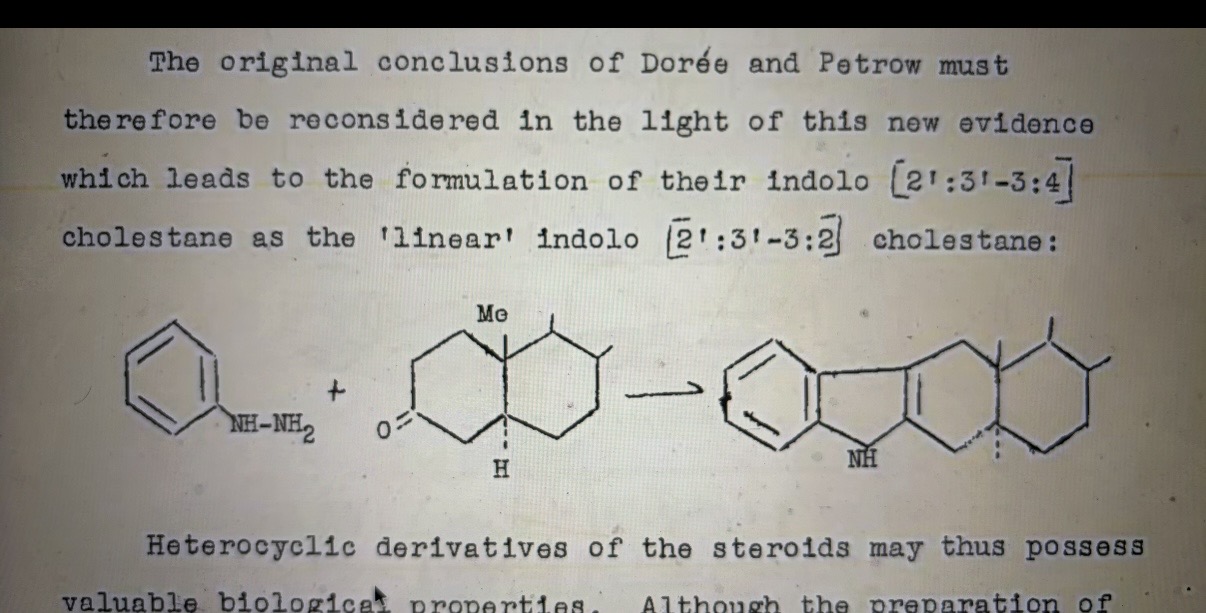
The structural correction formed part of a broader programme in Part II of Antaki’s 1950 doctoral thesis, Contributions to the Chemistry of Heterocyclic Compounds. After reviewing the individual heterocyclic steroid derivatives then known, Antaki proposed that such compounds might possess valuable biological properties and wrote that “the systematic study of the limitations in their preparation inherent in the steroid structure has not hitherto been attempted.” He stated that Part II had been undertaken with that objective in view.
The programme was multi-family in scope. Antaki applied heterocycle-forming reactions to steroid substrates and prepared quinolino-, indolo-, pyrrolo-, thiazolo- and diazacarbazolo/triazafluoreno steroid systems for biological investigation. Later specialist literature retained several of these syntheses as early precedents, while the indolo branch also produced the structural correction described above.
Antaki also stated the practical limitations of the work. Cholestanone was then the most readily accessible steroid ketone starting material, and the introduction of basic nuclei had not yet produced compounds with sufficient solubility for biological study. Nevertheless, the investigation moved beyond proposal: representative fused heterocyclic steroids were actually synthesised and compounds from the programme were submitted for biological testing.
Fused Heterocyclic Steroids: A Systematic Synthetic Programme, 1950–1951 →
The correctly assigned fused indolo-steroid later served as the rigid donor–acceptor scaffold in Haugland, Yguerabide and Stryer’s experimental test of Förster energy-transfer theory (Proc. Natl. Acad. Sci. USA, 1969, 63, 23; DOI 10.1073/pnas.63.1.23). Their N-methylindole donor and ketone acceptor were held 10.2 Å apart on the steroid framework.
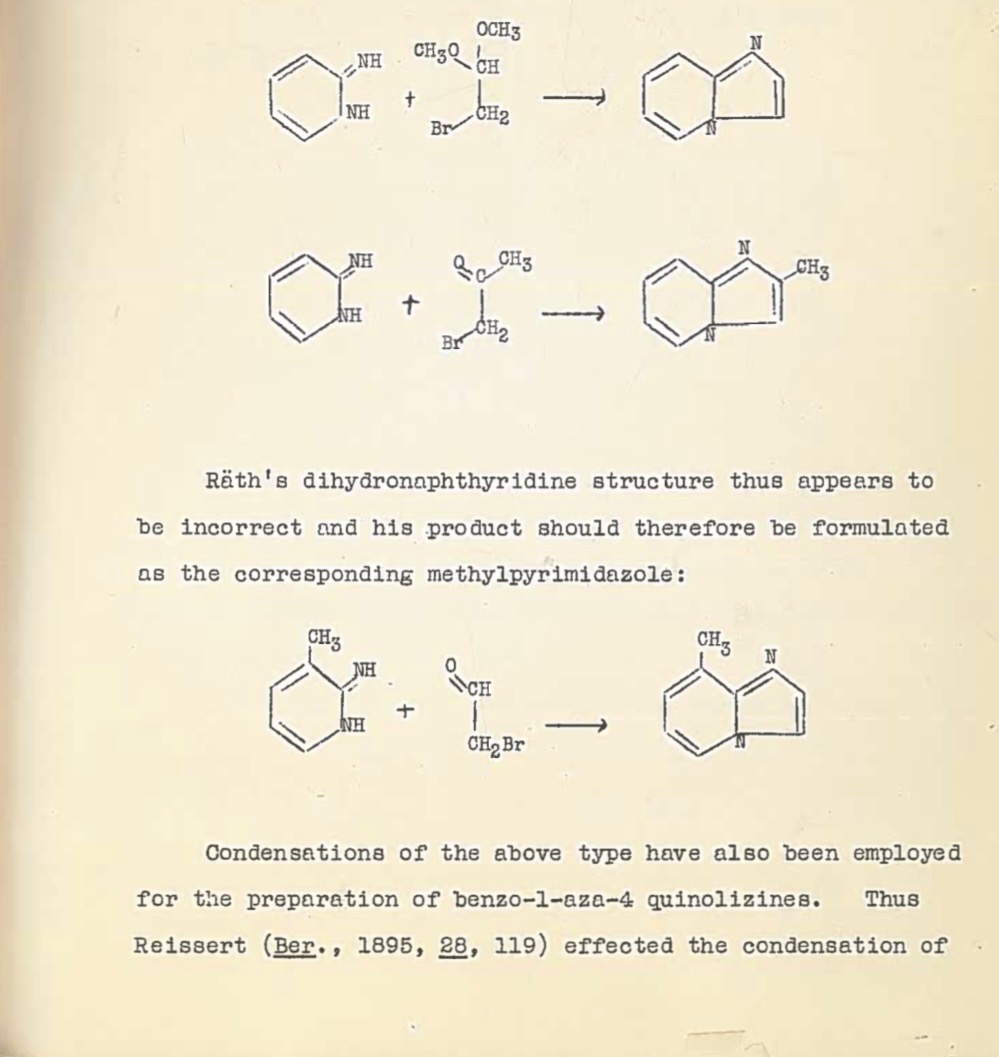
In 1925, Otto Räth reacted 2-amino-3-methylpyridine with bromoacetal and described the product as 1,2-dihydro-1,8-naphthyridine — a six-membered ring closure onto the pyridine ring nitrogen (Ber. 1925, 58, 347).
In reviewing routes to the 1-aza-4-quinolizine system in his 1950 doctoral thesis, Antaki first reproduced Räth's 1925 reaction and the dihydronaphthyridine structure assigned to its product. He then compared it directly with Tschitschibabin's closely analogous condensations of 2-aminopyridine with monobromoacetaldehyde dimethyl acetal and monochloroacetone, which gave five-membered pyrimidazole and methylpyrimidazole products rather than six-membered naphthyridines.
"Räth's dihydronaphthyridine structure thus appears to be incorrect and his product should therefore be formulated as the corresponding methylpyrimidazole."
In his third 1951 paper (J. Chem. Soc., 1951, 2873–2877; DOI 10.1039/jr9510002873), Antaki and Petrow synthesised glycosylbenzimidazoles as potential inhibitors of vitamin B₁₂, preparing 2-methyl- and 2,5-dimethyl-1-(β-D-glucopyranosyl)benzimidazoles and the corresponding xylopyranosyl compounds by treatment of N-(tetra-O-acetyl-d-glucopyranosyl)-o-phenylenediamine with ethyl orthoacetate, isolation of the acetimidate intermediate, and acid-induced ring closure.
The work was incorporated soon afterwards into the broader carbohydrate-chemistry literature. Ellis and Honeyman's review "Glycosylamines" (Advances in Carbohydrate Chemistry, 1955, 10, 95–168; DOI 10.1016/S0096-5332(08)60391-4) included several glycosylamine intermediates reported by Antaki and Petrow in its reference tables of known glycosylamines.
The 1951 paper subsequently entered several further lines of literature. In his review of vitamin B₁₂ chemistry (Bonnett, Chem. Rev., 1963, 63, 573; DOI 10.1021/cr60226a002), Antaki and Petrow were credited with having proposed that the o-xylene substitution pattern shared by riboflavin and the 5,6-dimethylbenzimidazole nucleotide of B₁₂ might derive from a common biogenetic source. Bonnett recorded the proposal in his discussion of biogenesis. More than half a century later, work on the enzyme BluB showed that flavin mononucleotide is converted directly into 5,6-dimethylbenzimidazole, providing later biochemical support for the biosynthetic relationship Antaki and Petrow had proposed from structural analogy in 1951.
In their review of benzimidazole nucleosides (Townsend and Revankar, Chem. Rev., 1970, 70, 395; DOI 10.1021/cr60265a005), the paper was cited for the specific synthetic procedure and the compounds prepared, placing the orthoacetate cyclisation within the developing benzimidazole-nucleoside methodology alongside other routes recorded in the review.
The same 1951 paper later entered pharmaceutical patent prior art: Glaxo Group and the University of Michigan cited Antaki and Petrow directly in WO 1998056761A3 on benzimidazole derivatives.
A further line of continuity runs through a documented unsuccessful experiment. Antaki and Petrow attempted to prepare the glycoside of 2-methyl-5,6-dichlorobenzimidazole by condensation with the silver salt of the heterocycle. The attempt was unsuccessful and was recorded as such in the 1951 paper. Six years later, Kissman, Child and Weiss (J. Am. Chem. Soc., 1957, 79, 1185–1188; DOI 10.1021/ja01562a041) cited that unsuccessful attempt directly in the literature context for their synthesis of 1-β-D-ribofuranosyl-5,6-dichlorobenzimidazole (DRB). Their paper records the earlier result as part of the reasoning that led them away from direct glycosylation and toward an alternative method based on the mercuric chloride procedure of Davoll and Brown.
Antaki had already used ultraviolet absorption as structural evidence in his 1950 doctoral thesis, where the spectra supported his interpretation of the fused pyrido[1,2-a]pyrimidine system. He extended that work in 1958 and 1962 from structural evidence on individual compounds to a systematic study of the ultraviolet behaviour of the class.
In his 1958 paper in the Journal of the American Chemical Society — submitted from the Research Institute for Tropical Medicine, Cairo, and received October 15, 1957 — Antaki examined the absorption behaviour across the pyrido[1,2-a]pyrimidine series (J. Am. Chem. Soc. 1958, 80, 3066–3069; DOI 10.1021/ja01545a041). He identified the characteristic long-wavelength absorption and related it to the chromophore of the fused system. His 1962 study (J. Org. Chem. 1962, 27, 1371–1374; DOI 10.1021/jo01051a058) clarified the electronic origin of the bands and set out the class-level chromophore rules established by Antaki for interpreting these spectra, including the contribution of the N-substituted pyridone-2-imine chromophore and the β-amino-α,β-unsaturated system.
"This may be considered as evidence for the major contribution of zwitterionic fully aromatic structures such as VIII to the resonance state of the molecule."
The chromophore rules set by Antaki in the 1958–1962 work were subsequently tested against further members of the series and became part of the later literature used to interpret pyrido[1,2-a]pyrimidine ultraviolet spectra.
The scaffolds Antaki studied later became relevant across several areas of medicinal chemistry.
Cardiovascular. In their 1989 retrospective account of calcium-channel-blocker research, Bossert and Vater write that "hexahydroquinoline derivatives… aroused our interest", citing Antaki's 1963 paper as reference 7. DOI: 10.1002/med.2610090304.
Antiparasitic. Antaki's published work included schistosomicidal screening of pyrido[1,2-a]pyrimidine derivatives in 1958 and 1962, within the tropical-medicine programme in Cairo. The hexahydroquinoline scaffold has since drawn renewed interest in antimalarial drug discovery.
Anticancer / fluorescence. Antaki himself recorded "intense blue fluorescence" for the fully reduced pentacyclic benz[h]indenoquinoline he prepared in 1967 (J. Chem. Soc. C, 1967, 1581–1582; DOI: 10.1039/J39670001581). Closely related indenoquinoline systems have subsequently been investigated for DNA intercalation, topoisomerase inhibition, and blue-emitting OLED applications.
Drug metabolism / schistosomiasis. In 1968, Antaki and J. Tewfik studied the metabolic fate of nitrothiamidazole (niridazole) in bilharzial patients. They isolated the reduced 5-amino metabolite from urine, confirmed its identity by independent synthesis, and developed a spectrophotometric method based on its absorption at 370 nm to follow its urinary excretion. The paper was later cited in the IARC Monographs, Vol. 13 (1977) on niridazole for spectroscopic data and urinary analysis.
In 1954 the Egyptian Ministry of Health constituted the Unit for Study and Eradication of Malaria in Egypt; Antaki joined that year, on returning from London. As malaria declined, the unit's mandate broadened, and in 1961 it became the Research Institute of Medical Entomology. Antaki retired as director in 1983.
Egypt was certified malaria-free by the World Health Organization on 20 October 2024 — through decades of public health effort in Egypt, including at institutions like his own — seventy years after the institution was founded, forty-one after he left it.