Fused Heterocyclic Steroids: A Systematic Synthetic Programme, 1950–1951
Fusing heterocyclic rings to the steroid nucleus later became an important strategy in medicinal chemistry. Pyrrolo-, indolo-, thiazolo-, pyrazolo-, pyrimidino- and other heterocyclic steroids were subsequently investigated for anabolic, anti-inflammatory, cardiovascular, antimicrobial, antitumour and other biological properties.
A systematic programme of this kind is documented in the 1950 doctoral thesis of Hekmat Bechir Fathallah Antaki, Contributions to the Chemistry of Heterocyclic Compounds, submitted at Queen Mary College, University of London.
In Part II of the thesis, after reviewing the heterocyclic steroid derivatives then known, Antaki proposed that such compounds might possess valuable biological properties and identified what he regarded as the unresolved synthetic problem:
“the systematic study of the limitations in their preparation inherent in the steroid structure has not hitherto been attempted”
He then stated that Part II of the investigation had been undertaken with that objective in view.
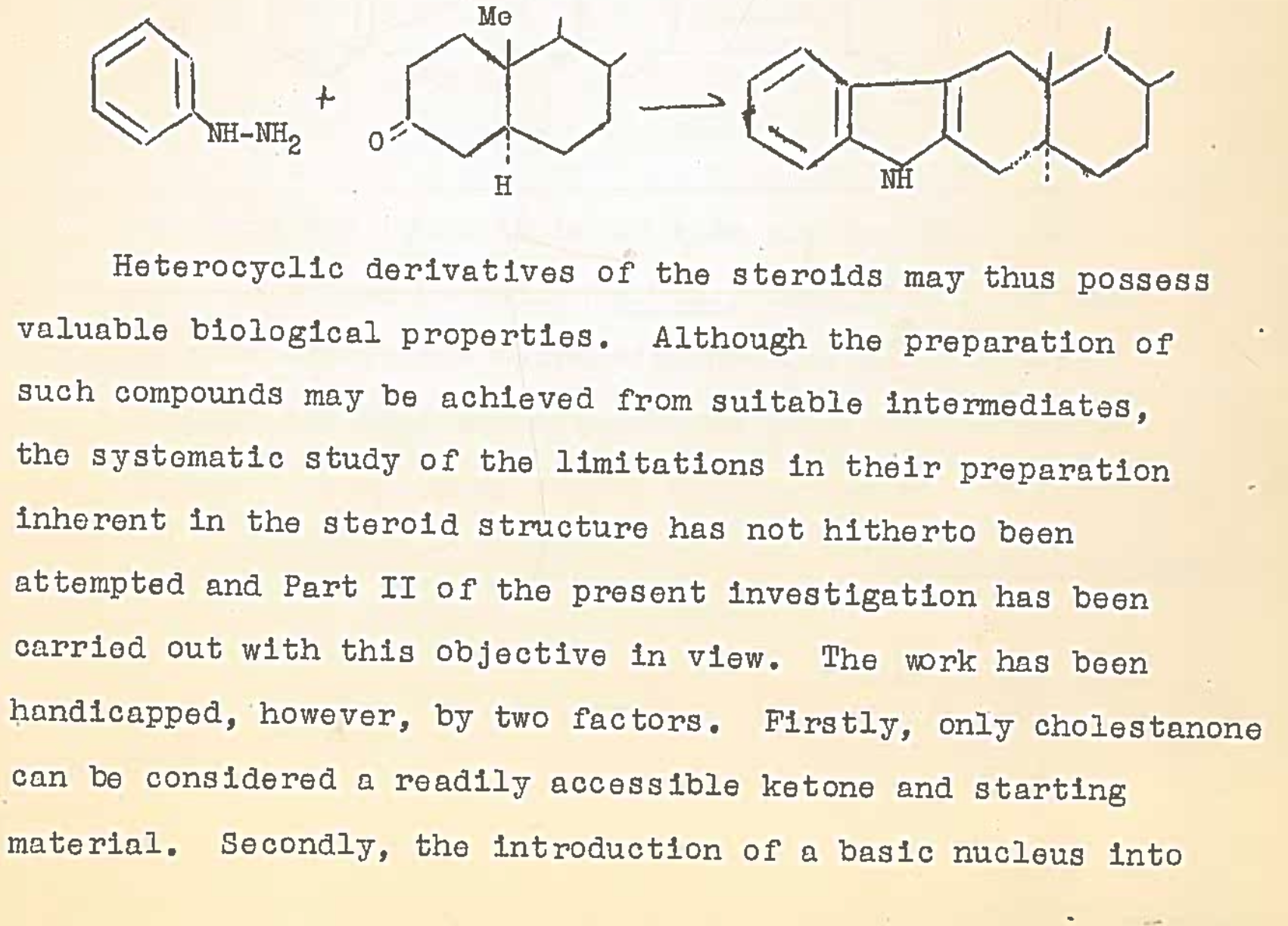
The programme was published with V. Petrow in 1951 as Steroids and Related Compounds. Part XII. Some Heterocyclic Derivatives, Journal of the Chemical Society, 1951, 901–904. DOI: 10.1039/JR9510000901.
The work treated fused heterocyclic steroid synthesis as a systematic field of investigation across several ring families and was undertaken with biological investigation in view.
A Multi-Family Steroidal Heterocycle Programme
The investigation did not concentrate on a single ring system. Antaki applied established heterocycle-forming reactions to steroid ketones and related intermediates and prepared representatives of several fused families: quinolino-steroids, indolo-steroids, pyrrolo-steroids, thiazolo-steroids, and a steroidal system described in the thesis using diazacarbazolo terminology and later in specialist literature as a triazafluoreno derivative.
The significance of the programme therefore lies not simply in the preparation of individual compounds, but in treating fused heterocyclic steroid synthesis as a systematic multi-family programme.
Later steroid-heterocycle reviews described a closely comparable rationale for the field. Akhrem and Titov's 1967 review discussed condensed heterocyclic steroids as a medicinal-chemistry strategy directed toward compounds with anabolic, anti-inflammatory, hypotensive, antitumour and other physiological activities.
A. A. Akhrem and Yu. A. Titov, “Derivatives of Steroids with Condensed Heterocycles,” Russian Chemical Reviews, 1967, 36, 311–325. DOI: 10.1070/RC1967v036n05ABEH001616.
Quinolino-Steroids
Antaki extended established quinoline-forming chemistry to additional steroid ketones and derivatives.
Earlier work by W. Borsche and R. Frank had already produced quinoline-fused derivatives of bile-acid-related steroid systems. Antaki's investigation broadened the application of quinoline-forming chemistry within the steroid series and included derivatives prepared with biological investigation in view.
W. Borsche and R. Frank, Berichte der Deutschen Chemischen Gesellschaft, 1924, 57, 1373–1380. DOI: 10.1002/cber.19240570828.
Indolo-Steroids: Structural Correction
The indolo branch produced a different kind of contribution.
In 1935, Dorée and Petrow had formulated the Fischer-indole product obtained from cholestan-3-one as an angular indolo-cholestane. The thesis records that the formulation was supported by a study of molecular area in unimolecular films, the results of which were compatible with an angular structure, then the preferred formulation.
In his 1950 thesis, Antaki reconsidered that structure in light of the established chemistry of the cholestanones and reassigned the product to the linear indolo[2′:3′-3:2]cholestane structure.
“The original conclusions of Dorée and Petrow must therefore be reconsidered in the light of this new evidence…”
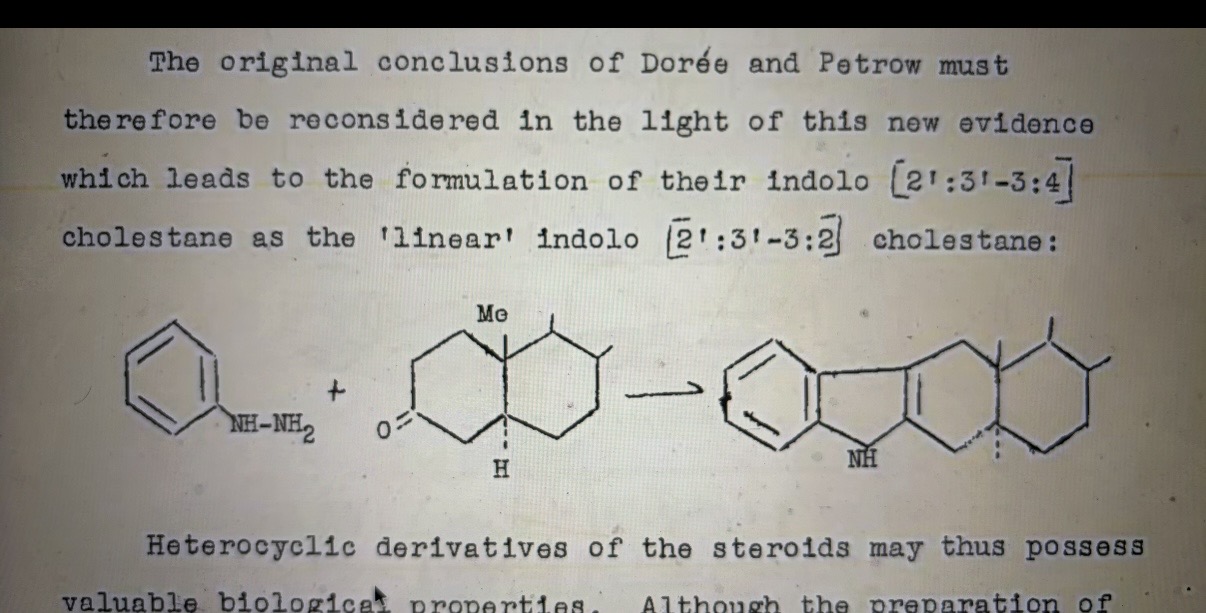
The reasoning is set out on pages 91–94 of the thesis. Antaki drew on the evidence that had accumulated since 1935 on the relative reactivity of the C2 and C4 methylene groups, which showed that in the cholestanone series C2 is the active methylene group. Bromination gives 2-bromocholestanone (Butenandt and Wolff), selenium dioxide oxidation gives cholestan-2:3-dione (Rosenheim and Stiller), and sulphonation gives cholestan-3-one-2-sulphonic acid (Windaus and Kuhr). In each case the structure was established by conversion to known compounds, including, for the dione, the dicarboxylic acid obtained earlier by Windaus and Uibrig. The thesis concludes that this evidence leads to the linear formulation.
The reassignment was published in compressed form in Antaki and Petrow's 1951 paper. DOI: 10.1039/JR9510000901.
Fourteen years later, Yoshio Ban and Yasuhiko Sato established the structure experimentally by chemical degradation, carrying the product through ozonolysis and subsequent reactions to the known Windaus–Uibrig acid, the same acid the thesis had cited in establishing the C2-substituted cholestanone derivatives. Their paper explicitly records that the earlier angular formulation had been revised by Antaki and Petrow to the linear structure.
Y. Ban and Y. Sato, “Studies on the Structures of Some Cholestanoindoles,” Chemical and Pharmaceutical Bulletin, 1965, 13, 1073–1077. DOI: 10.1248/cpb.13.1073.
B. Robinson later recorded the same reformulation in his review of the Fischer indole synthesis.
B. Robinson, “Recent Studies on the Fischer Indole Synthesis,” Chemical Reviews, 1969, 69, 227–250. DOI: 10.1021/cr60258a004.
The corrected indolo-steroid subsequently remained a working structural precedent in later Fischer-indole chemistry. In their study of the Fischer-indole cyclisation of cholestan-3-one phenylhydrazones, Harvey and Reid cite Antaki and Petrow's 1951 paper for the formation of 5α-cholest-2-eno[3,2-b]indole from 5α-cholestan-3-one, noting that the position of ring fusion parallels the direction of enolisation of the 3-oxo group and that both are governed by stereochemistry at C-5. They cite Ban and Sato for the establishment of these structures by chemical degradation.
D. J. Harvey and S. T. Reid, “Phenylhydrazones and N-Methylphenylhydrazones of Some 6-Substituted Cholestan-3-ones,” Tetrahedron, 1972, 28, 2489. DOI: 10.1016/0040-4020(72)80084-X.
A related steroidal indole framework also became part of a rigid molecular system used by Haugland, Yguerabide and Stryer in an experimental test of intramolecular Förster energy transfer. Their work cited Antaki and Petrow in connection with the Fischer-indole synthesis of the steroidal system.
R. P. Haugland, J. Yguerabide and L. Stryer, Proceedings of the National Academy of Sciences USA, 1969, 63, 23. DOI: 10.1073/pnas.63.1.23.
Pyrrolo-Steroids: An Early Steroidal Knorr Synthesis
Antaki and Petrow also applied pyrrole-forming chemistry to the steroid nucleus.
Later specialist literature retained this synthesis in the history of steroidal pyrroles. In their 1967 review, Zhungietu and Dorofeenko describe use of the Knorr method for steroidal pyrrole formation, including the condensation leading to an ethyl carboxy-methyl pyrrolocholestane, and cite Antaki and Petrow's 1951 paper as the source.
G. I. Zhungietu and G. N. Dorofeenko, “Progress in the Field of the Chemistry of Steroidal Heterocycles,” Russian Chemical Reviews, 1967, 36, 24–37. DOI: 10.1070/RC1967v036n01ABEH001581.
Akhrem and Titov likewise describe formation of steroido[3,2-b]pyrroles from cholestane 3-ketosteroids and cite Antaki and Petrow among the sources for the route.
Thiazolo-Steroids: Later Development
Antaki and Petrow prepared a 2′-aminothiazolo-fused cholestane by reaction of a brominated steroid ketone with thiourea.
In 1962, Norman J. Doorenbos and Conrad P. Dorn Jr. published Steroids IX. Synthesis of Some Thiazolosteroids. They prepared 2′-aminothiazolo[d-3,2]-5α-cholest-2-ene by the same general chemistry and gave the earlier reported melting point and optical rotation, citing Antaki and Petrow 1951 as reference 13.
N. J. Doorenbos and C. P. Dorn Jr., “Steroids IX. Synthesis of Some Thiazolosteroids,” Journal of Pharmaceutical Sciences, 1962, 51, 414–417. DOI: 10.1002/jps.2600510504.
A dedicated 1981 review of steroidal thiazoles, isothiazoles, thiazolines and thiazolidines also includes Antaki and Petrow's 1951 paper among the early sources for steroido[3,2-d]thiazoles.
P. Catsoulacos and Ch. Camoutsis, “Steroidal Thiazoles, Isothiazoles, Thiazolines and Thiazolidines,” Journal of Heterocyclic Chemistry, 1981, 18, 1485–1505. DOI: 10.1002/jhet.5570180801.
Diazacarbazolo / Triazafluoreno Steroids
The thesis describes this branch of the programme using diazacarbazolo terminology.
Antaki and Petrow obtained the product from 2-hydroxymethylenecholestan-3-one and 2-aminobenzimidazole.
Akhrem and Titov, discussing a product obtained from the same two starting materials, identify it as cholestano[3,2-b]-1′,9′,11′-triazafluorene and cite Antaki and Petrow's 1951 paper as the source.
A. A. Akhrem and Yu. A. Titov, “Derivatives of Steroids with Condensed Heterocycles,” Russian Chemical Reviews, 1967, 36, 311–325. DOI: 10.1070/RC1967v036n05ABEH001616.
Historical Record
The programme brought together quinolino-, indolo-, pyrrolo- and thiazolo-steroid chemistry, together with the branch described in the thesis using diazacarbazolo terminology. Later specialist literature continued to cite Antaki and Petrow's 1951 work in connection with the pyrrolo-, thiazolo- and triazafluoreno branches, while the indolo-steroid reassignment was subsequently confirmed and retained in later structural literature.
More broadly, Antaki's 1950 thesis explicitly framed the work as a systematic investigation of heterocyclic ring formation within the steroid structure, undertaken with biological investigation in view. The 1951 paper then reported several distinct fused heterocyclic steroid families arising from that programme.
The historical significance of the work therefore rests most firmly on the documented conception and execution of a systematic, multi-family programme of fused heterocyclic steroid synthesis in 1950–1951.
From an Early Programme to a Field
By the 1960s, fused heterocyclic steroid chemistry had expanded substantially. Specialist reviews classified steroidal pyrroles, indoles, pyrazoles, thiazoles, triazoles, pyridines, quinolines, pyrimidines and other condensed systems, while medicinal studies explored how changing the fused heterocycle altered biological activity.
Akhrem and Titov summarized the mature rationale of the field in 1967: heterocyclic modification of the steroid skeleton was being pursued in the hope of producing compounds with biological properties different from those of the parent steroid, including anabolic, anti-inflammatory, hypotensive and antitumour effects.
That rationale is visible in Antaki's thesis seventeen years earlier. Immediately before stating his objective, he wrote:
“Heterocyclic derivatives of the steroids may thus possess valuable biological properties.”
His objective, quoted at the outset of this page, was the systematic study of the limitations in their preparation inherent in the steroid structure.
References
- Antaki, H. B. F. Contributions to the Chemistry of Heterocyclic Compounds. PhD thesis, Queen Mary College, University of London, May 1950, Part II, pp. 91–94.
- Antaki, H.; Petrow, V. Steroids and Related Compounds. Part XII. Some Heterocyclic Derivatives. J. Chem. Soc. 1951, 901–904. DOI: 10.1039/JR9510000901.
- Borsche, W.; Frank, R. Ber. Dtsch. Chem. Ges. 1924, 57, 1373–1380. DOI: 10.1002/cber.19240570828.
- Ban, Y.; Sato, Y. Studies on the Structures of Some Cholestanoindoles. Chem. Pharm. Bull. 1965, 13, 1073–1077. DOI: 10.1248/cpb.13.1073.
- Doorenbos, N. J.; Dorn, C. P. Jr. Steroids IX. Synthesis of Some Thiazolosteroids. J. Pharm. Sci. 1962, 51, 414–417. DOI: 10.1002/jps.2600510504.
- Zhungietu, G. I.; Dorofeenko, G. N. Progress in the Field of the Chemistry of Steroidal Heterocycles. Russ. Chem. Rev. 1967, 36, 24–37. DOI: 10.1070/RC1967v036n01ABEH001581.
- Akhrem, A. A.; Titov, Yu. A. Derivatives of Steroids with Condensed Heterocycles. Russ. Chem. Rev. 1967, 36, 311–325. DOI: 10.1070/RC1967v036n05ABEH001616.
- Robinson, B. Recent Studies on the Fischer Indole Synthesis. Chem. Rev. 1969, 69, 227–250. DOI: 10.1021/cr60258a004.
- Haugland, R. P.; Yguerabide, J.; Stryer, L. Proc. Natl. Acad. Sci. USA 1969, 63, 23. DOI: 10.1073/pnas.63.1.23.
- Harvey, D. J.; Reid, S. T. Phenylhydrazones and N-Methylphenylhydrazones of Some 6-Substituted Cholestan-3-ones. Tetrahedron 1972, 28, 2489. DOI: 10.1016/0040-4020(72)80084-X.
- Catsoulacos, P.; Camoutsis, Ch. Steroidal Thiazoles, Isothiazoles, Thiazolines and Thiazolidines. J. Heterocycl. Chem. 1981, 18, 1485–1505. DOI: 10.1002/jhet.5570180801.
Sources cited in the thesis (pp. 91–93) for the indolo reassignment:
- Dorée, C.; Petrow, V. J. Chem. Soc. 1935, 1391.
- Butenandt, A.; Wolff, A. Ber. Dtsch. Chem. Ges. 1935, 68, 2091.
- Windaus, A.; Kuhr, E. Justus Liebigs Ann. Chem. 1937, 532, 52.
- Rosenheim, O.; Stiller, H. J. Chem. Soc. 1938, 353.
- Windaus, A.; Uibrig, C. Ber. Dtsch. Chem. Ges. 1914, 47, 2384.