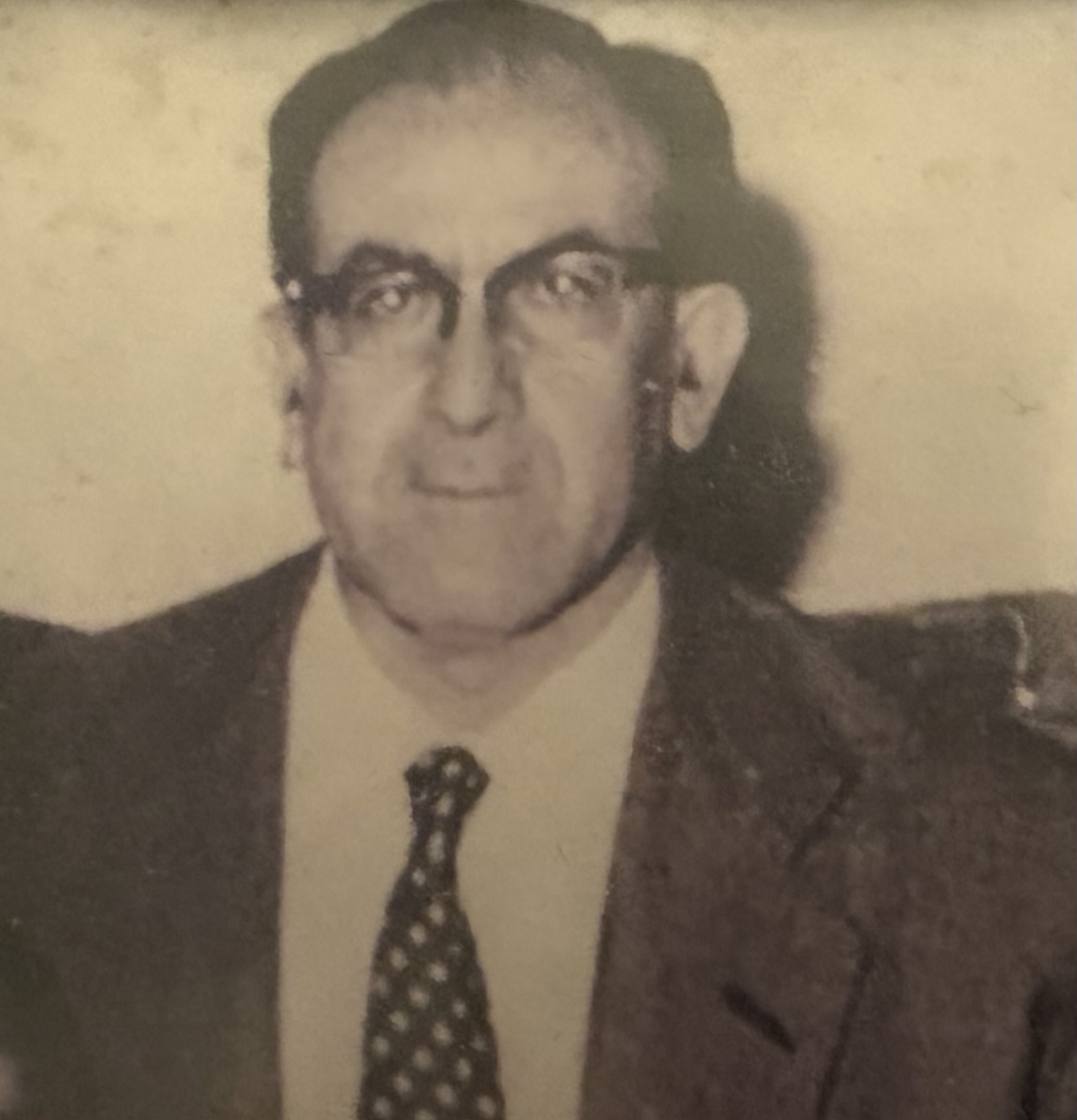
H. B. F. Antaki, Cairo, circa 1960s
Hekmat Bechir Fathallah Antaki was an Egyptian organic chemist. He completed his doctoral degree at Queen Mary College, University of London, in 1950, under the supervision of J.R. Partington. He returned to Egypt and joined the Research Institute for Tropical Medicine, Cairo, where he conducted an independent programme of research in heterocyclic chemistry between 1951 and 1967. He subsequently served as Director of the Research Institute of Medical Entomology, Cairo.
He published eight papers in four leading chemistry journals between 1951 and 1967. Working without university affiliation, he developed multicomponent condensation methods for the synthesis of pharmacologically relevant heterocyclic scaffolds. His 1962 paper was submitted from his home address in Agouza, Cairo — self-funded research by a working scientist.
His published work was characterized by rigorous bibliographic integrity. His 1965 paper cited foundational research dating back to Bongartz (1888), Stobbe and Volland (1902), and Colange, Dreux and Delplace (1957) — tracking sources spanning 76 years without access to electronic databases, digital libraries, or search engines. Working from Cairo, with whatever physical library resources were available, he credited prior work precisely and completely. He did not claim what was not his.
Across eight papers, Antaki's work established two heterocyclic scaffolds, each now recognised in medicinal chemistry.
A privileged scaffold in medicinal chemistry, its derivatives studied across cardiovascular, antiallergic, antiasthmatic and antiparasitic research. The structure of the parent ring system was established by Antaki and Petrow (1951) and credited as "first described by Antaki" in the authoritative review of the series (Hermecz and Mészáros, Advances in Heterocyclic Chemistry, Vol. 33, 1983).
This ring system is the heterocyclic core of the antipsychotics risperidone and paliperidone. The defining patent (US 4,804,663) names as its two most-preferred compounds the reduced 6,7,8,9-tetrahydro-2-methyl-4H-pyrido[1,2-a]pyrimidin-4-one (the risperidone ring) and the corresponding aromatic 2-methyl-4H-pyrido[1,2-a]pyrimidin-4-one. The marketed drugs carry the ring in reduced, 3-substituted form — paliperidone being the 9-hydroxy metabolite of risperidone. The ring system is the one established in 1951; the reduction, 3-substitution and pharmacology are Janssen's.
A scaffold of active medicinal interest, belonging to the privileged quinoline family and pursued in current anticancer and antimalarial research. Antaki reported the first practical three-component synthesis of the 4-aryl-hexahydroquinoline in 1963 — a method now formally named the Antaki synthesis (Oduselu et al., Frontiers in Chemistry, 2026). The inventors of nifedipine cited the 1963 paper in the synthetic lineage of the dihydropyridine calcium-channel blockers (Bossert and Vater, 1989). The scaffold remains an active platform across the pharmaceutical patent record.
Independent parties — patent attorneys, review authors, and research chemists — described his work in their own words. None was obliged to mention him.
"The synthesis of a 1H-pyrimido[1,2-a]quinoline appears to have first been reported by Antaki et al., J. Chem. Soc., pp. 551–555 (1951)."
— Pfizer, US 4,066,766 (1978)
"hexahydroquinoline derivatives… aroused our interest."
— Bossert and Vater, inventors of nifedipine, citing Antaki's 1963 paper at that step. Medicinal Research Reviews 9, 291 (1989).
Products of 4-methylpyridine and ethoxymethylene cyanoacetate "were first described by Antaki."
— Hermecz and Mészáros, the canonical review of the ring system. Advances in Heterocyclic Chemistry, Vol. 33 (1983).
Their products were "identical in m.p., ir, uv, and pmr spectra… as described by Antaki and Petrow" — confirmed by X-ray crystallography and NMR.
— Yale, Toeplitz, Gougoutas and Puar, Squibb Institute for Medical Research. J. Heterocyclic Chem. (1972/73).
"Suitable reaction conditions are also reported by Antaki in J. Chem. Soc., 4877 (1963)."
— Zeneca, EP 0539154 (1997).
The full record — patents, reviews, reference works, and laboratory use, in their authors' own words: In Their Own Words
"Traditional multicomponent reactions such as the Hantzsch, Antaki, and Stankevich methods are discussed alongside more recent green synthetic strategies." — Oduselu et al., Frontiers in Chemistry, 2026.
"The compounds of formula I wherein R is 5-nitro-2-furyl, 3-nitrophenyl and 4-nitrophenyl are known, for example from… Antaki, J. Chem. Soc., 4877 (1963)."
"Suitable reaction conditions are also reported by Antaki in J. Chem. Soc., 4877 (1963)." — US 5,258,390, Imperial Chemical Industries PLC, 1993.
| # | Patent | Assignee | Published | Paper cited |
|---|---|---|---|---|
| 1 | US 3,538,086 | CIBA (Switzerland) | 1970-11-03 | 1951 JCS |
| 2 | US 4,014,881 | Pfizer | 1977-03-29 | 1951 JCS + 1958 JACS |
| 3 | US 4,017,625 | Pfizer | 1977-04-12 | 1951 JCS + 1958 JACS |
| 4 | US 4,022,897 | E.R. Squibb | 1977-05-10 | 1951 JCS |
| 5 | US 4,031,217 | Pfizer | 1977-06-21 | 1951 JCS + 1958 JACS |
| 6 | US 4,041,163 | Pfizer | 1977-08-09 | 1951 JCS |
| 7 | US 4,066,766 | Pfizer | 1978-01-03 | 1951 JCS + 1958 JACS |
| 8 | US 4,122,274 | Bristol-Myers | 1978-10-24 | 1958 JACS |
| 9 | US 4,209,620 | Bristol-Myers | 1980-06-24 | 1958 JACS |
| 10 | US 4,223,031 | Mead Johnson | 1980-09-16 | 1951 JCS |
| 11 | US 4,491,587 | Mead Johnson | 1985-01-01 | 1951 JCS |
| 12 | US 5,166,206 | Merck | 1992-11-24 | 1951 JCS |
| 13 | EP 0539153 | Zeneca | 1993 | 1963 JCS |
| 14 | EP 0539154 | Zeneca | 1993 | 1963 JCS |
| 15 | US 5,258,390 | ICI/AstraZeneca | 1993-11-02 | 1963 JCS |
| 16 | CA 2080950 | ICI / Zeneca | 1993 | 1963 JCS |
| 17 | CA 2080949 | ICI / Zeneca | 1993 | 1963 JCS |
| 18 | US 5,324,729 | Merck | 1994-06-28 | 1951 JCS |
| 19 | US 5,340,819 | ICI | 1994-08-23 | 1951 JCS |
| 20 | US 5,455,253 | Zeneca | 1995-10-03 | 1963 JCS |
| 21 | US 5,484,792 | ICI | 1996 | 1963 JCS |
| 22 | US 5,622,964 | Zeneca | 1997-04-22 | 1963 JCS |
| 23 | US 8,716,319 | Gilead Sciences | 2014-05-06 | 1963 JCS |
| 24 | WO 2015/002150 | Shin Nippon Biomedical Labs | 2015-01-08 | 1951 JCS |
| 25 | US9745274 | Shin Nippon Biomedical Labs | 2017-08-29 | 1951 JCS |
Twenty-five patents verified at text level. Ten independent companies. Six countries. 1970–2016. Full record with remarks: In Their Own Words
In 1911, Palazzo and Tamburini prepared the first compound in the pyrido[1,2-a]pyrimidine series but assigned it the wrong structure (2-oxo instead of 4-oxo). This error was repeated by Seide (1925) and Crippa & Scevola (1937) and remained in the chemical literature for nearly forty years.
In 1951, Hekmat Bechir Fathallah Antaki, working with V. Petrow at Queen Mary College London, resolved the long-standing error. Using an independent synthesis (reacting 2-bromopyridine with ethyl β-aminocrotonate), they conclusively demonstrated that the correct structure was the 4-oxo isomer — borrowing the words of Hermecz and Mészáros (Advances in Heterocyclic Chemistry, Vol. 33, 1983): "unequivocal synthesis." This assignment was later confirmed by Adams and Pachter (1952) and explicitly credited as the definitive proof by Shur and Israelstam (1968) and by Hermecz and Mészáros, who further noted it was "first described by Antaki" (p. 269).
In 1958, in his paper to the Journal of the American Chemical Society — submitted from the Research Institute for Tropical Medicine, Cairo, and received October 15, 1957 — Hekmat Bechir Fathallah Antaki published the first systematic ultraviolet absorption spectra of the pyrido[1,2-a]pyrimidine class (J. Am. Chem. Soc. 1958, 80, 3066–3068). He identified a constant feature across all compounds in the class — intense absorption in the region 330–390 mμ — and provided the mechanistic explanation: conjugative interaction with the β-amino-α,β-unsaturated ketone or nitrile chromophore. He further argued, in his own words:
"This may be considered as evidence for the major contribution of zwitterionic fully aromatic structures such as VIII to the resonance state of the molecule."
This is not a recording of spectral data. It is a structural argument — establishing from spectroscopic evidence the electronic character of an entire compound class. The absorption pattern was not random. It was systematic, mechanistically explained, and structurally significant.
His 1962 paper (J. Org. Chem. 1962, 27, 1371–1374) further clarified the mechanistic origin of these bands. Both assignments were independently confirmed by Shur and Israelstam (1968) and were later adopted as the standard reference by Hermecz and Mészáros in their 1983 canonical review.
Together, the 1951 structural correction and the 1958–1962 UV characterization provided the reliable foundation for the pyrido[1,2-a]pyrimidine series. This foundation enabled much of the subsequent chemical development and the pharmaceutical applications that followed in the decades after.
The scaffolds Antaki studied later became relevant across several areas of medicinal chemistry.
Cardiovascular. In their 1989 account of the path to nifedipine (Medicinal Research Reviews 9, 291), Bossert and Vater trace the chemistry from khellin through the chromones to the moment "hexahydroquinoline derivatives… aroused our interest" — citing Antaki's 1963 paper (ref. 7) at exactly that step. The hexahydroquinoline was the scaffold immediately preceding the 1,4-dihydropyridine that became nifedipine; Antaki appears again in the synthetic lineage (ref. 13), alongside Knoevenagel (1898). The broader 1,4-dihydropyridine calcium-channel-blocker class includes amlodipine, felodipine and nicardipine.
Antiparasitic. Antaki designed his programme for diseases of resource-limited settings; his 1962 paper noted schistosomicidal activity. The hexahydroquinoline scaffold has since drawn renewed interest in antimalarial drug discovery.
Anticancer / fluorescence. The pentacyclic benz[h]indenoquinoline he first made in 1967 belongs to a class now studied for DNA intercalation, topoisomerase inhibition, and blue-green fluorescence.
In 1954 the Egyptian Ministry of Health constituted the Unit for Study and Eradication of Malaria in Egypt; Antaki joined that year, on returning from London. As malaria declined, the unit's mandate broadened, and in 1961 it became the Research Institute of Medical Entomology — described in its own materials as the only institute in the Arab world specialising in insect-borne diseases and a WHO training centre for vector-borne disease control. Antaki retired as its President in 1983.
Egypt was certified malaria-free by the World Health Organization on 20 October 2024 — seventy years after the institution was founded, forty-one after he left it.